Search This Blog

Thursday, April 12, 2018

Who should do a Paycheck Checkup?

Following tax law changes, your clients should do a paycheck checkup using the IRS’s Withholding Calculator and, if necessary, complete a new  W-4 form. The calculator helps determine the right amount of withholding.  

Your clients should check if they:
  •          Are a two-income family
  •          Have two or more jobs at the same time or only work part of the year
  •          Claim credits like the child tax credit
  •          Have dependents age 17 or older
  •          Itemized deductions in 2017
  •          Have high income or a complex tax return
  •          Have a large tax refund or tax bill for 2017

Visit IRS.gov/withholding for details.

Wednesday, April 11, 2018

Paycheck Checkup -- IRS Withholding Calculator

REMINDER: The Tax Cuts and Jobs Act made major changes to the tax law. Because of this, your clients should do a paycheck checkup using the Withholding Calculator.

Recent changes affecting withholding include: 
  • Reduced tax rates 
  • Elimination of personal exemptions
  • Increased standard deductions: $12,000 for singles, $18,000 for heads of households and $24,000 for married couples filing jointly
  • Increased child tax credit: $2,000 per qualifying child and a new $500 credit for other qualifying dependents 
  • Changes to itemized deductions

Monday, April 9, 2018

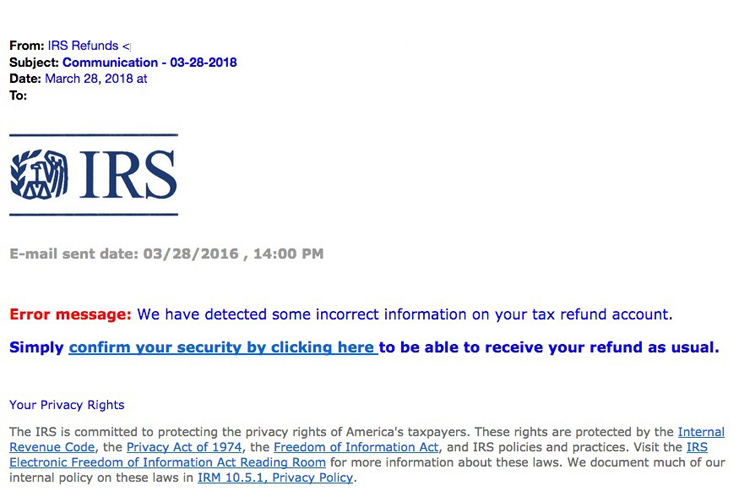
IRS Press Release: IRS, Summit Partners warn on tax deadline scams, ‘IRS Refunds’ email

IRS Press Release:
==================
IR-2018-88 April 9, 2018
WASHINGTON – With the April 17 tax deadline approaching, the Internal Revenue Service and Security Summit partners urge taxpayers and tax professionals to be alert to identity theft scams, especially a new email version currently pretending to be from “IRS Refunds.”
As the filing season comes to a close, thieves are stepping up their efforts, warned the Internal Revenue Service and the Security Summit partners. The Security Summit, a partnership between the IRS, state tax agencies and the tax industry, continues to take steps to combat tax-related identity theft.
The “IRS Refunds” scam is a common tactic used by cybercriminals to trick people into opening a link or attachment associated with the email. This link takes people to a fake page where thieves try to steal personally identifiable information, such as Social Security numbers.
Often these links or attachments also secretly download malware that can perform many functions, such as giving the thief control of the computer or tracking keystrokes to determine other sensitive passwords or critical data.
The IRS does not randomly contact taxpayers or tax professionals via email, including asking people to confirm their tax refund information. The IRS initiates most contacts through regular mail delivered by the United States Postal Service.
However, there are special circumstances in which the IRS will call or come to a home or business, such as when a taxpayer has an overdue tax bill, to secure a delinquent tax return or a delinquent employment tax payment, or to tour a business as part of an audit or during criminal investigations.
Even then, taxpayers will generally first receive several letters (called “notices”) from the IRS in the mail.

Note that the IRS does not:

  • Demand that taxpayers use a specific payment method, such as a prepaid debit card, gift card or wire transfer. The IRS will not ask for debit or credit card numbers over the phone. Taxpayers should make check payments to the “United States Treasury” or review IRS.gov/payments for IRS online options.
  • Demand that taxpayers pay taxes without the opportunity to question or appeal the amount they say is owed. Generally, the IRS will first mail a bill to those who owe any taxes. Taxpayers should also be advised of their rights as a taxpayer.
  • Threaten to bring in local police, immigration officers or other law-enforcement to have taxpayers arrested for not paying. The IRS also cannot revoke a driver’s license, business license or immigration status. Threats like these are common tactics scam artists use to trick victims into buying into their schemes.
With scams like these circulating, taxpayers and tax professionals should take ongoing security precautions to protect their identities and their computer networks from identity thieves.
Here are a few basic security steps for taxpayers:
  • Always use security software with firewall and anti-virus protections. Make sure the security software is always turned on and can automatically update. Encrypt sensitive files such as tax records stored on computers. Use strong, unique passwords for each account.
  • Learn to recognize and avoid phishing emails, threatening calls and texts from thieves posing as legitimate organizations such as banks, credit card companies and even the IRS. Do not click on links or download attachments from unknown or suspicious emails.
  • Protect personal data. Don’t routinely carry Social Security cards, and make sure tax records are secure. Shop at reputable online retailers. Treat personal information like cash; don’t leave it lying around.
Here are few basic security steps for tax professionals:
  • Learn to recognize phishing emails, especially those pretending to be from the IRS, e-Services, a tax software provider or cloud storage provider. Never open a link or any attachment from a suspicious email. Remember: the IRS never initiates initial contact with tax pros via email.
  • Create a data security plan using IRS Publication 4557, Safeguarding Taxpayer Data, and Small Business Information Security – The Fundamentals, by the National Institute of Standards and Technology.
  • Review internal controls:
    • Install anti-malware/anti-virus security software on all devices (laptops, desktops, routers, tablets and phones) and keep software set to automatically update.
    • Use strong and unique passwords of 10 or more mixed characters, password-protect all wireless devices, use a phrase or words that are easily remembered and change passwords periodically.
    • Encrypt all sensitive files/emails and use strong password protections.
    • Back-up sensitive data to a safe and secure external source not connected fulltime to a network.
    • Wipe clean or destroy old computer hard drives that contain sensitive data.
    • Limit access to taxpayer data to individuals who need to know.
    • Check IRS e-Services account weekly for number of returns filed with EFIN.
  • Report any data theft or data loss to the appropriate IRS Stakeholder Liaison.
  • Stay connected to the IRS through subscriptions to e-News for Tax ProfessionalsQuick Alert and Social Media.

Friday, April 6, 2018

Reminder that this Year's April Filing Deadline is April 17

This a reminder that the federal filing deadline for individual returns is Tuesday, April 17, 2017.
It is April 17 instead of Monday April 16 because of the Emancipation Day holiday in the District of Columbia.
For e-filed returns that are rejected on April 17, the return will be considered timely filed if it is retransmitted and accepted by April 22.
The first federal individual 2018 estimated payment is also due by April 17.
April 17 is also the deadline for the following:
  • To file an automatic six month extension (Form 4868) for individual federal returns. Remember the six month extension is for filing the return only. Any tax due must be paid by April 17 to avoid any penalty and interest.
  • Making a contribution to an IRA for tax year 2017
  • Filing 2017 calendar year federal corporate tax returns (Form 1120)
  • Filing 2017 estate or trust income tax returns (Form 1041)
  • Filing an FBAR (FinCen Form 114) for individuals that have foreign financial accounts over $10,000 at any time during 2017
The filing deadline is automatically extended (without having to file a Form 4868) for the following taxpayers:
  • U.S. citizens and resident aliens who live and work abroad, as well as members of the military on duty outside the U.S. have until June 15 to file and pay any tax due, although interest will be charged from April 17 on any tax that is paid on June 15.
  • Members of the military and others serving in a combat zone localities receive an automatic extension of the due date until at least 180 days after they leave the combat zone to file returns and pay any taxes due. For more details see Extensions of Deadlines on page 28 of Publication 3 (Armed Forces’ Tax Guide).

Monday, April 2, 2018

IRS Press Release: IRS urges ‘Paycheck Checkup’ for key groups; tax withholding may need adjustment

IRS Press Release
====================

IR-2018-80, April 2, 2018
WASHINGTON — The Internal Revenue Service today encouraged several key groups of taxpayers to perform a “paycheck checkup” to check if they are having the right amount of tax withholding following recent tax-law changes.
The IRS emphasizes the new tax law changes make it especially important for specific groups of taxpayers to visit the Withholding Calculator on IRS.gov. This includes people in households with two or more jobs, who have children or dependents, who itemize their taxes, or who have high incomes or complex tax situations.
"It's important every year for people to review if they're having the right amount of tax withheld from their paychecks," said Acting IRS Commissioner David Kautter. "This year, it's even more urgent for people to review their situation following the new tax law changes. As people complete their 2017 tax returns, this is a perfect time to take a paycheck checkup."
The IRS unveiled several new features to help taxpayers understand the implications of the new Tax Cuts and Jobs Act and navigate the complex issues affecting withholding. During the Paycheck Checkup campaign, the IRS is highlighting these efforts, including new YouTube videos and a special Tax Tip series.
The centerpiece of the effort is the updated Withholding Calculator on IRS.gov.
The new tax law could affect how much tax someone should have their employer withhold from their paycheck. Using the Withholding Calculator can help prevent employees from having too little or too much tax withheld.
Having too little tax withheld can mean an unexpected tax bill or potentially a penalty at tax time in 2019. And with the average refund topping $2,800, some taxpayers might prefer to have less tax withheld up front and receive more in their paychecks.
Taxpayers can use the Withholding Calculator to estimate their 2018 income tax. The Withholding Calculator compares that estimate to the taxpayer’s current tax withholding and can help them decide if they need to change their withholding by submitting a new W-4 form to their employer. When using the calculator, it’s helpful to have a completed 2017 tax return available.
Special alert for key groups to check withholding
The IRS always recommends employees check their withholding at the beginning of each year or when their personal circumstances change to make sure they’re having the right amount of tax withheld from their paychecks.
Following the recent tax law changes, it’s especially important for certain people to use the Withholding Calculator on IRS.gov to check if they are having the right amount of withholding.
Among the groups, in particular, who should check their withholding are people who:
  • Belong to a two-income family.
  • Work two or more jobs or only work for part of the year.
  • Have children and claim credits such as the Child Tax Credit.
  • Have older dependents, including children age 17 or older.
  • Itemized deductions on their 2017 tax returns.
  • Earn high incomes and have more complex tax returns.
  • Received large tax refunds or had large tax bills for 2017.
"The IRS urges people in these groups to take a few minutes and review their withholding and tax situation," Kautter said. "Taking this step will help avoid surprises next year at tax time."
The new law increased the standard deduction, removed personal exemptions, increased the child tax credit, limited or discontinued certain deductions, and changed the tax rates and brackets.
Withholding calculator helps with Form W-4; submit to employer as soon as possible
Taxpayers can use the results from the Withholding Calculator to help determine if they should complete a new Form W-4, Employee’s Withholding Allowance Certificate, and, if so, what information to put on it. Employees will submit the completed Form W-4 form to their employer.
When changes in personal circumstances reduce withholding allowances they are entitled to claim--including divorce, starting a second job, or a child no longer being a dependent--employees have 10 days to submit a new Form W-4 to their employer claiming the proper number of withholding allowances.
Employees who need to adjust their withholding should do so as quickly as possible so there’s more time for tax withholding to take place evenly during the rest of the year. Waiting until later in the year means there are fewer pay periods to make the tax changes – which could have bigger consequences for each paycheck.
To use the Withholding Calculator, taxpayers should have their 2017 tax returns and most recent paystubs ready. Having a completed 2017 tax return can help taxpayers work with the Withholding Calculator to help determine their proper withholding for 2018 and avoid issues when they file next year.
Taxpayers should remember that the tax law changes generally don’t affect 2017 returns that people are filing in early 2018. They affect returns for 2018, which taxpayers will file in 2019. The Withholding Calculator helps taxpayers check their 2018 withholding for their 2018 situation, including recent law changes.
Withholding Calculator results depend on the accuracy of information entered. Taxpayers whose personal circumstances change during the year should return to the calculator to check whether their withholding should be changed.
For more details on withholding issues, taxpayers are encouraged to visit IRS.gov.
More information:

© CrossLink Professional Tax Solutions